What is agrivoltaics?
Published on November 29, 2023

Agri-food
Agri-food
Agri-food
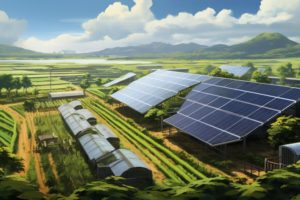
Agrivoltaics, a definition with a "ruralist" spirit
- The main purpose of agrivoltaics is the installation, maintenance and development of agricultural production. The main activity must remain agricultural.
- A definition of agrivoltaics composed of multiple cardinal and technical notions from rural law:
-
- WHERE? Agricultural plot: practical notion that is only defined in Article D. 614-32 of the CRPM, for the allocation of CAP aid: "corresponds to a continuous agricultural area, greater than or equal to one are, presenting the same characteristics."
-
- WHAT? The main activity and agricultural production : two concepts that are close to that of "agricultural activity" within the meaning of Article L. 311-1 of the Rural and Maritime Fishing Code (CRPM). Assessing the "main" criterion of agricultural activity requires technical and legal expertise regarding production volume, income level or even the land footprint of each specific project, similar to what is practiced under the regulations relating to structural control.
-
- WHO? The active farmer: a recent, complex and evolving concept (Article D. 614-1 of the CRPM) notably allowing access to CAP aid, which combines notions of rural law, social law and company law.
-
- HOW? The list of services (4) to be provided to the agricultural plot: close alignment with the objectives of the policy in favor of agriculture, food, and maritime fisheries (Articles L.1 to L.4 of the CRPM), also involving a technical and agronomic approach to the activity, the issue of quality labels (labels, HVE…), and inspiration from the environmental clauses that can be integrated into a rural lease
-
- HOW? Procedures: preliminary agricultural study within the meaning of Article L. 112-1-3 of the CRPM, and opinion of the CDPENAF.
- Rural law concepts that will, in the near future, need to be analyzed through the lens of the upcoming implementing decree (in principle announced for the end of September).
The fundamental respect for regulations
- Les projets agrivoltaïques doivent s’opérer dans le strict compliance with regulations set by rural law(V. de l’article L. 314-36 du Code de l’énergie), et notamment :
- The status of farm tenancy: a status created in 1946 whose main objective is to extend the rights of the tenant on the land he farms to the detriment of the owner.
A powerful derogatory regime, of public order and binding, which must be followed with caution.
- The missions of the Sociétés d'Aménagement Foncier et d'Etablissement Rural (SAFER): commercial companies entrusted with public service missions. They intervene in the restructuring of agricultural holdings and the establishment of farmers, in actions in favor of local development, environmental protection, or the enhancement of natural areas.
SAFERs have a formidable means of action: the right of pre-emption, which can be a powerful obstacle to access to land, within the framework of long and uncertain procedures.
Eligibility of agrivoltaic projects for CAP aid
- L’article L. 314-38 du Code de l’énergie, issu de la loi No. 2023-175 of March 10, 2023 relating to the acceleration of renewable energy production,confirme que :
- "The presence of agrivoltaic installations, within the meaning of Article L. 314-36, (...) does not prevent the eligibility of these same surfaces for interventions in the form of direct payments," under the direct payments regime of Regulation (EU) 2021/2115 of the European Parliament and of the Council of 2 December 2021.
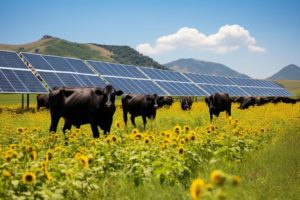
- Cette disposition conforte the attractiveness of agrivoltaic projectsen preserving the eligibility of farmed agricultural areas for CAP subsidies, malgré la présence d’une installation photovoltaïque sur le terrain exploité :
- A considerable asset for the development of agrivoltaic projects;
- An essential financial security for the farmer.
- Une technical and complex regulationsà appliquer :
- Eligibility conditions that are evolving and variable due to the new concept of "active farmer";
- Multiple interactions with rural stakeholders: D.T, MSA…
The agrivoltaic lease, a tool for resolving land-use conflict
What is the agrivoltaic lease?
- A tool for resolving the conflict of interest between the farmer and the energy producer concerning land use;
- A tool for adapting the common law contractual framework in agrivoltaic matters, in the form of derogatory provisions;
- A tool inspired by existing derogatory rural leases (environmental lease and assignable lease…), through the insertion of clauses resulting from the consent of the tenant and the landlord;
- A tool adapted to the usual relationships between landlord and tenant farmer, to contemporary agricultural issues, in strict compliance with the complex status of tenant farming, and without substantial modification thereof.
The interests of the agrivoltaic lease
- Resolve the conflict of interest related to land use by securing the synergy between agricultural activity, which must remain primary, and electricity production activity;
- Enable the sharing of value from the photovoltaic installation to contribute to the establishment, maintenance, and development of agricultural activity through financial support;
- Allow reducing the amount of rent, as is done in the case of environmental rural leases;
- Include clauses aimed at ensuring the tenant's compliance with farming practices intended to preserve and ensure the proper functioning of the agrivoltaic installation;
- Simplify contractual arrangements by avoiding the superimposition, on the same land, of emphyteutic leases, rural leases, and free loan agreements.
The agrivoltaic lease: a necessary creation to be reprogrammed
- Rejection of the amendment proposal aimed at creating the agrivoltaic lease within Law No. 2023-175 of March 10, 2023 relating to the acceleration of renewable energy production;
- A necessary creation to be reprogrammed following the establishment of a new definition of agrivoltaics and its legal framework by the law of March 10, 2023.
Amendment relating to "Specific provisions for agrivoltaic rural leases"
“Art. L. 419-1. Clauses aimed at ensuring the tenant's compliance with agricultural practices intended to preserve and ensure the proper functioning of the agrivoltaic installation, as defined in Article L. 314-36 of the Energy Code, may be included in the rural lease. When the rural lease is in progress, the clauses as defined in the first paragraph of this article may be added by way of an amendment without this constituting a renewal of said lease.”
"Article L.419-2. The lease including a clause mentioned in Article L.419-1 sets the conditions under which the lessor can ensure compliance by the lessee with the agreed cultivation practices."
“Art. L. 419-3. The inclusion in the lease contract of clauses based on Article L. 419-1 is subject to the condition that a sharing of the value from the electrical production of the agrivoltaic installation is carried out between the energy producer and the tenant. This sharing of value takes the form of a commitment by the energy producer to associate the tenant with the revenues of the agrivoltaic installation. A certificate of the existence of this commitment is attached to the rural lease.”
Partners
Universes
Agri-food