Tire abrasion and the environmental responsibility of producers: between diffuse pollution and ecological damage in light of the Euro 7 regulation.
Published on March 18, 2026

Environment
Environment
Environment
Microplastic pollution has emerged as one of the major contemporary issues in environmental law, both because of the scale of its effects and the difficulty of its legal understanding. Among the identified sources, tire abrasion occupies a particular place: a phenomenon inherent to the normal use of the vehicle, it is today one of the main sources of primary microplastics released into the environment in Europe. These particles, resulting from the mechanical wear of tires, disperse diffusely into the air, soil and aquatic environments, particularly through rainwater runoff, escaping the classic categories of industrial or accidental pollution.
The case of Lake Annecy is an emblematic illustration of the legal tensions raised by this diffuse pollution. Long presented as one of the purest lakes in Europe, it recently was the subject of a joint investigation by the association Agir pour l'environnement and investigative journalists from France 5, revealing the presence of so-called "emerging" pollutants from tire abrasion. Notably identified were diphenylguanidine (DPG), 6PPD, and especially 6PPD-quinone (6PPD-Q), a degradation byproduct of an additive commonly used in tires to improve their durability and resistance to oxidation. These substances are currently identified by scientists for their proven or suspected toxicity to aquatic biodiversity, particularly on the reproduction and survival of certain fish species.
This local situation is part of a broader context.
Aux États-Unis, elle a conduit dès 2023 à des actions contentieuses d’ampleur engagées par le cabinet EarthJustice contre 13 grands fabricants de pneumatiques.
In France, the association France Nature Environnement Haute-Savoie states that "Several studies show that tire microplastics are the 1st source of plastic pollution in water", while several bodies of water have recently been subject to usage restrictions, particularly in the Pyrenees where anti-swimming orders have been issued due to various types of pollution, notably attributed to the use of mosquito spray, dog collars, and sunscreen.
Faced with these scientific findings, the law finds itself confronted with a paradox: while the reality of environmental damage is hardly in doubt, its legal attribution remains uncertain. Pollution from tire abrasion, which is diffuse, cumulative, and multifactorial, challenges the traditional frameworks of civil, administrative, and criminal liability, while revealing the structural limitations of existing mechanisms for preventing and repairing ecological harm. The question then arises as to whether tire manufacturers can, and must, be held legally responsible for damage resulting from the normal use of their products.
In this context, the adoption of the Euro 7 European regulation in 2024 appears as a major normative turning point. By including for the first time binding requirements on particle emissions from tire abrasion, independently of exhaust gas emissions, the European legislator seems to shift the center of gravity of environmental responsibility: from waste management to product design, and from end-of-life to the emission itself.
I. Tire abrasion: scientifically established but legally unclear
Particles from tire abrasion result from a mechanical phenomenon inherent in the normal use of the product. They are neither a voluntary discharge nor an industrial accident, which creates a legal issue.
The legislator subjects producers, through Article L. 541-10 of the Environmental Code, to a principle of extended responsibility and in particular to "provide for or contribute to the prevention and management of waste arising from them" but also to adopt an approach "of treating their waste and developing the recycling of waste from products". Thus, if waste prevention and recycling are provided for by law, can particles from normal use of the product be considered waste?
Law No. 2003-1312 of the Amending Finance Act for 2003, of December 30, 2003, introduced a new article L.541-10-1 in the Environmental Code. The latter provides that the following fall under this liability regime: "16° Tires, whether or not combined with other products, the approval procedures for eco-organizations and individual systems being applicable from January 1, 2023;"
As such, only the tire is targeted and not the particles emitted by its wear.
Regulation (EU) 2024/1257 of the European Parliament and of the Council of 24 April 2024 on type-approval of motor vehicles and engines, and of systems, components and separate technical units intended for such vehicles, with regard to their emissions and battery durability ('Euro 7'), has established a definition of 'tire abrasion' as the mass of material lost from the tire due to the abrasion process and emitted into the environment, but also as 'non-exhaust emissions', i.e., evaporative emissions, tire abrasion emissions, and brake emissions. [1]
Euro 7 regulation will therefore, from its entry into force on November 29, 2026, for the first targeted vehicle category, shed at least some light on the situation.
But who will repair the pollution?
II. The environmental civil liability of tire manufacturers: a theoretical basis, practical obstacles
A. Civil liability for fault and compensation for ecological damage
After the famous Erika case[2] and since the law of August 8, 2016 on biodiversity, which codified case law, Articles 1246 to 1252 of the Civil Code establish an autonomous regime for the reparation of ecological damage. Article 1246 states that "Any person responsible for ecological damage is required to repair it."
Ecological damage is defined as a "non-negligible" harm to the elements or functions of ecosystems[3], and its reparation is primarily carried out in kind[4].
In theory, this regime could apply to the pollution of Lake Annecy by microplastics from tire abrasion.
But in practice, three major obstacles remain:
- the identification of an author: dispersed among a plurality of actors (producers, distributors, users) and part of a complex causal chain. This configuration makes it difficult to directly attribute ecological damage such as the pollution of a lake to a specific author.
- establishing a sufficient causal link,
- demonstrating the non-negligible nature of the damage attributable to a specific actor.
B. Liability for things and defective products
Other grounds may be considered:
- liability for things[5], as long as the tire can be considered the instrument of damage;
- liability for defective products[6], if the tire does not offer the safety one can legitimately expect.
However, these regimes were designed primarily to compensate for harm to persons or property, and their transposition to ecological damage remains uncertain. No case law has, to date, recognized the defective nature of a product solely because of its environmental impact in normal use, and especially in the absence of specific standards imposing a limitation on tire abrasion.
III. Administrative and criminal liability: a shift of litigation towards the public authority
A. Administrative liability for failure or inaction
In matters of pollution, liability is often shifted to the public authorities. The administrative judge admits the liability of the State or local authorities in case of:
- deficiency in the exercise of water police powers[7],
- inadequacy of prevention measures[8],
- or inaction in the face of scientifically established pollution[9]
If this action reminds us of the famous judgment of the Administrative Court of Paris of February 3, 2021, "The Case of the Century"; in the case of Lake Annecy, an action could thus target not tire manufacturers, but the competent authorities in matters of stormwater management and protection of aquatic environments.
B. Criminal liability: a still largely inoperative field
Environmental criminal law remains marked by low effectiveness. Existing offenses are difficult to enforce against tire manufacturers in the absence of precise regulatory obligations regarding abrasion. Abrasion pollution does not, as it stands, constitute an autonomous criminal offense.
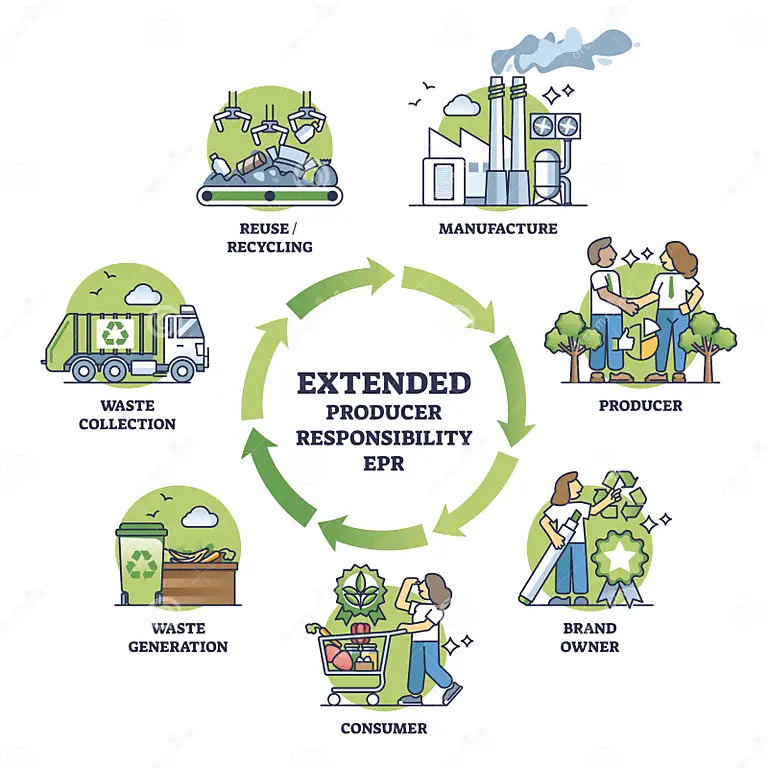
IV. Extended Producer Responsibility (EPR) for tires: a waste-centered regime
A. The legal framework of EPR applicable to tires
Article L. 541-10 of the Environmental Code subjects producers to an extended producer responsibility regime, requiring them to provide for or contribute to the prevention and management of waste from their products.
Law n°2003-1312 of December 30, 2003 expressly integrated tires into this system via article L.541-10-1, 16°, with effective application on January 1, 2023. This regime is specified by articles R.543-137 et seq. of the Environmental Code, amended by decree n°2023-152 of March 2, 2023.
B. An extensive notion of the "producer"
The concept of producer is not limited to the tire manufacturer. It includes:
- importers,
- distributors,
- resellers marketing tires under their own brand,
- as well as operators introducing products equipped with tires on the national market for the first time.
This extension aims to ensure the effectiveness of used tire management.
C. A regime strictly limited to waste management
Article L.541-10-2 specifies that financial contributions cover the costs of prevention, collection, transport, and treatment of waste, including abandoned or irregularly stored waste.
Administrative case law has confirmed that the holder of used tires remains responsible for their effective disposal, regardless of contracts concluded with service providers[10].
On the other hand, particles from tire abrasion do not constitute waste within the meaning of these provisions. They are emitted before any waste phase and therefore fall outside the scope of the REP scheme.
V. Euro 7 Regulation: towards a reshaping of responsibilities
A. Introduction of binding standards regarding tire abrasion
The Euro 7 European regulation, adopted in 2024, marks a major break by integrating, for the first time, requirements relating to particle emissions from tire abrasion, independently of exhaust gas emissions.
This text explicitly recognizes that these emissions constitute a significant source of pollution and imposes measurable and harmonized requirements on manufacturers at the European level.
Recital 20 of the regulation states that: "Non-exhaust emissions consist of particles emitted by vehicle tires and brakes. Tire emissions are estimated to be the main source of microplastics released into the environment."[11]
Article 4 of the same regulation sets obligations for manufacturers regarding the construction of vehicles, systems, components, and separate technical units: “Manufacturers shall ensure that new vehicles they manufacture, which are sold, registered, or put into service in the Union, are type-approved in accordance with this regulation. From the specific application dates set out in this regulation, manufacturers shall ensure that new systems, components, or separate technical units, including engines, traction batteries, braking systems, tires, and replacement anti-pollution systems requiring type approval that they manufacture and which are sold or put into service in the Union, are type-approved in accordance with this regulation. [12]”
Without going into technical details, this regulation:
- Requires manufacturers to design vehicles that comply with emission limits over the lifetime of a vehicle;
- Modifies the installation of onboard surveillance systems and onboard fuel and energy consumption monitoring systems;
- Prohibits manipulation and tampering devices1/defeat strategies;
- Requires reporting of environmental data and an environmental passport for the vehicle.
B. The expected legal effects
The gradual entry into force of Euro 7 is likely to profoundly transform litigation:
- in civil liability, the violation of regulatory thresholds will make it easier to characterize a fault;
- in product liability, a non-compliant tire could be classified as a defective product;
- in administrative and criminal liability, failure to comply with the obligations arising from the regulation will constitute an objective breach.
Conclusion
Under current positive law, it is not really possible to hold tire manufacturers liable for pollution resulting from tire abrasion, particularly regarding diffuse pollution of Lake Annecy. Neither the environmental civil liability regime, nor extended producer responsibility, nor criminal law currently allow for direct and effective attribution.
The Euro 7 regulation nevertheless constitutes a major normative tipping point. By shifting attention from waste to emissions and from the end of life of the product to its design, it paves the way for increased producer responsibility, which will make it possible to operationalize the legal remedy for diffuse pollution related to tire abrasion.
[1] Euro 7 Regulation: Article 3
[2] Court of Cassation, Criminal Chamber, Criminal Chamber, September 25, 2012, 10-82.938
[3] art. 1247 of the Civil Code
[4] art. 1249 of the Civil Code
[5] art. 1242 of the Civil Code
[6] art. 1245 et seq. of the Civil Code
[7] Council of State, 5th – 6th combined chambers, 22/07/2020, n°425969
[8] Council of State, 6th – 5th combined chambers, 07/24/2025, No. 496331
[9] Council of State, 6th - 1st combined chambers, 12/07/2017, no. 394254
[10] CAA Bordeaux, May 18, 2009, No. 08BX02156; CAA Bordeaux, March 1, 2016, No. 14BX00118
[11] Euro 7 Regulation
[12] Euro 7 Regulation: Article 4
Article written by Camille WAUTIER and Thomas-Duc DANG.
Universes

Environment